Address
15 Qingnian West Road, Shiyan Subdistrict, Bao’an District, Shenzhen, Guangdong, China.
Work Hours
Monday – Friday: 24 Hours
Weekend: 24 Hours
Last Updated: November 9, 2026
A clean, tangle-free wig can make a doll easier to style, but not every wig should be washed or brushed the same way. Before cleaning a sex doll wig, identify its fiber, cap construction and attachment method, and check the instructions supplied for that exact wig.
This guide covers preparation, gentle detangling, washing when permitted, drying and storage. It is a practical checklist rather than a promise that one shampoo, water temperature or routine works for every wig.
Find the wig or doll model, the fiber description and any care label or order notes. A wig may use conventional synthetic fiber, heat-friendly synthetic fiber, human hair or a blend. Its cap can include lace, glued sections or other delicate construction. The fiber and cap may have different limits, so ask the manufacturer or seller if the instructions are missing.
Check whether the wig is removable, sewn, clipped or attached with adhesive. If removal is not clearly supported, do not pull at the cap or try to dissolve adhesive. Ask the manufacturer how to clean it without damaging the doll’s finish, makeup, electronics or the attachment.
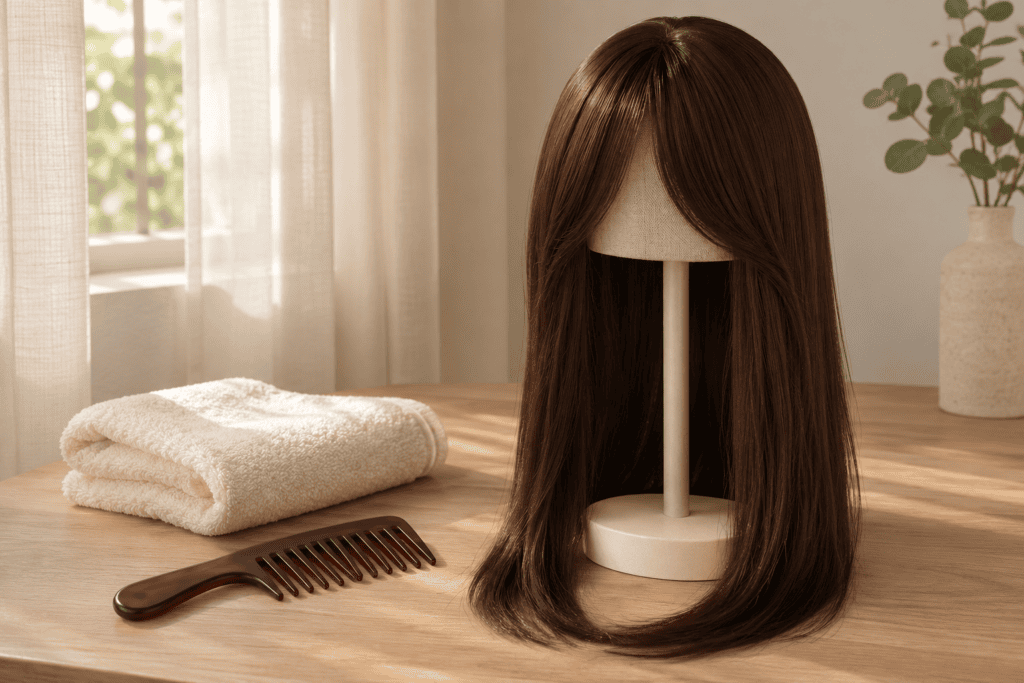
Set out a clean towel and a wide-tooth comb or the tool specified for the style. If the manufacturer permits washing, prepare the recommended wig cleanser and a clean basin or other equipment named in the instructions. A stand suitable for the wig can help it retain its shape while it dries. Do not assume a hair product intended for a person or another wig is suitable for this fiber or cap.
If removal is supported, follow the model’s instructions and support the cap as you lift it away. Work slowly around any fastening; stop if there is resistance. Keep washing products and water away from the doll’s face, makeup, eyes, seams and electrical components unless the product instructions explicitly permit contact. Clean the wig separately only when its construction and instructions allow it.
Follow the wig maker’s guidance on whether to comb before or after wetting, and on which comb or brush suits the hairstyle. For a style that permits combing, support the cap and work gently through small sections, starting at the ends and gradually moving toward the base. Do not pull the hair from the roots or force a knot.
Curly, tightly styled or hand-tied pieces may need a different approach to preserve their shape or attachment. If the instructions warn against brushing or the cap stretches, stop and seek model-specific advice. A little patience can reduce unnecessary tension, but neither synthetic nor human hair is guaranteed to stay tangle-free.
If the manufacturer confirms that the removed wig and cap can be washed, follow its directions for the cleanser, water, application and rinsing. Handle the fibers in their natural direction and avoid scrubbing, twisting or bunching them. Do not soak a wig, use hot water or leave it submerged for a set period simply because a general guide recommends it; adhesives, lace and fibers can respond differently.
Rinse or condition only as directed. Some wig makers specify a leave-in product, while others may advise against care products near the doll’s finish. Keep products away from the base when instructed, and avoid letting them run onto the doll. If the wig has makeup, adhesive or unidentified contamination that the instructions do not address, ask the maker before treating it.
As a manufacturer-specific example, Sino Doll’s care guide recommends gentle wig handling and air drying for its products. Jon Renau’s synthetic fiber guide describes a different product range and its own products and methods. Neither guide establishes the correct routine for every doll wig.
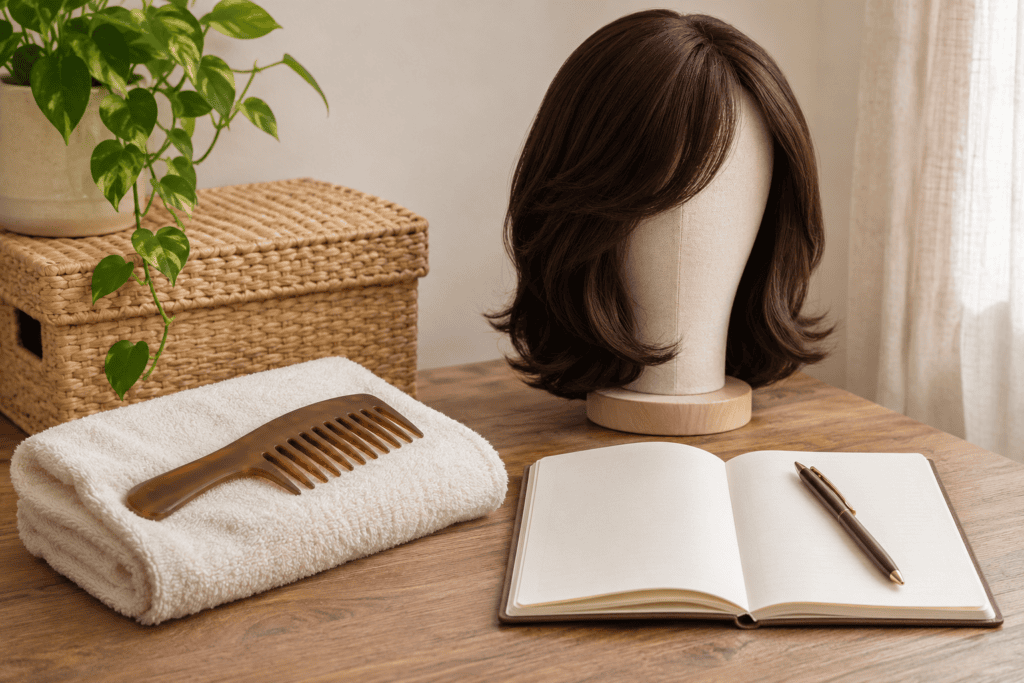
After an approved wash, gently blot excess moisture with a clean towel if the instructions allow it. Avoid wringing or rubbing the fibers or cap. Support the wig on a suitable stand and allow the fiber and cap to dry fully before storing or refitting it, following the manufacturer’s directions. Do not place a damp wig on the doll or enclose it while it is still wet.
Do not use a hair dryer, curling iron, straightener or other heated tool unless the maker explicitly permits it for the exact wig and provides the necessary instructions. A heat-friendly label for one product is not evidence that another synthetic wig, cap, adhesive or the doll’s surface can tolerate heat. Human-hair wigs also have construction and treatment limits; confirm the individual instructions rather than assuming unrestricted heat styling.
Once fully dry, store the wig in the manufacturer-recommended position or container, away from dust, direct sunlight, moisture and contact that could distort the style. If a stand or bag is recommended, make sure it fits without stretching the cap. Check that a wig cap, liner or dark material is compatible with the doll before prolonged contact, because color transfer can depend on the specific materials.
There is no universal interval: the right schedule depends on the maker’s instructions, exposure to dust or products, handling and the wig’s condition. Detangling and suitable storage may be appropriate between washes. Do not assume a fixed number of weeks applies to a display wig, a heat-friendly style and a human-hair piece alike.
Stop and contact the seller or manufacturer if fibers are shedding unusually, the cap or attachment is damaged, a knot cannot be eased without pulling, or you do not know whether the wig can be removed. Ask which products and procedures are approved, whether the wig can be professionally cleaned and whether replacement parts are available. LevDoll support can help identify the relevant model and instructions.
If you are also planning an outfit, the clothing and dressing guide covers fit and handling. Follow the particular doll’s care instructions when moving or dressing it; a wig-care procedure does not establish the cleaning requirements for the body.
Follow the wig maker’s instructions and consider its exposure, use and condition. A fixed interval does not suit every fiber, cap or storage situation.
Do not assume that you can. Check the attachment and the doll’s instructions first; keep water and care products away from makeup and electrical parts unless expressly permitted.
Ask the wig manufacturer which products are compatible with the exact fiber and cap. A product suitable for human hair or a different synthetic wig may not be suitable for yours.
Follow the instructions for that style. Some wigs require a wide-tooth comb, finger styling or another approach; avoid pulling through tangles or stretching the cap.
Use heat only if the manufacturer explicitly approves it for the exact wig and cap and provides instructions. Otherwise, follow its recommended air-drying method.
Stop pulling and ask the manufacturer or seller for the correct removal and cleaning method. Do not use an adhesive solvent unless it is specifically approved for the wig and doll finish.
Identify the fiber, cap and attachment before deciding how to detangle or clean. When an instruction is missing, ask the maker; careful support, approved products and complete drying are more useful than a one-size-fits-all washing recipe.


[…] the maker’s instructions. For a fuller discussion of preparation, washing and drying, see our sex doll wig cleaning guide. That guide does not replace the instructions for your specific […]