Address
15 Qingnian West Road, Shiyan Subdistrict, Bao’an District, Shenzhen, Guangdong, China.
Work Hours
Monday – Friday: 24 Hours
Weekend: 24 Hours
Complete guide to celebrity lookalike dolls. Learn about features, benefits, maintenance, and buying tips. Comprehensive review with expert recommendations.
Last Updated: November 11, 2026
“Soft silicone” and “hard silicone” are common descriptions in doll listings, but they do not tell you exactly how a complete product will feel. Manufacturers may use the terms for different formulations, body areas, layers or options. Compare the exact model and configuration rather than assuming a single industry-wide definition.
A good comparison considers the surface and internal construction, the available evidence, care instructions, handling requirements and price. This guide explains the questions to ask; it does not claim to have tested the products or establish that one firmness is best for everyone.
In a listing, “soft” generally describes an option presented as more yielding, while “hard” or “firm” describes a less yielding option. Ask what the comparison is made against. The terms alone do not specify an exact formula, a standardized feel or the hardness of every body part.
A maker may use a different material or firmness for the head, hands, outer surface or a local filling. A soft body option does not automatically make every area equally soft. Confirm whether the label describes the whole body, a skin layer, a single component or an optional insert.
For example, Irontech describes distinct filling options for certain areas of its own products and notes that the outer material also affects the overall feel. This is a manufacturer example, not proof of any option’s availability or feel on a different model or at another seller.
Start by matching the same manufacturer, body, size and material when possible. Ask how the two available options differ on that configuration and which areas are affected. Comparing different models at the same time makes it difficult to know whether a difference comes from the silicone or from the body’s design.
Ask for current manufacturer-provided photos, descriptions or samples where available, and confirm that any sample corresponds to the selected configuration. A video or sample can help explain the seller’s description but does not guarantee the sensation or exact appearance of the delivered item. Preferences and perceptions vary.
Thickness, shape, internal support, filling and surface finish can all be relevant to how a finished area feels. Ask about those details if they matter to your decision; a single material label cannot describe the complete construction.
Some suppliers describe a material using a Shore hardness value. Ask which scale and test method were used, whether the figure describes raw material, a molded sample or the finished component, and which part of the product it represents. The number must be read with its scale and context.
Do not compare a bare number from one listing with a number on a different scale as though the two were directly interchangeable. Ask for the underlying data sheet or test information and have the seller explain whether it applies to the current body and finish. If no figure is available, do not invent one from words such as “ultra soft.”
A hardness measurement also does not establish durability, lifespan, comfort, certification or suitability for a particular use. A small sample and a finished, layered body may be experienced differently; request model-specific information rather than promising that a number predicts the entire product.
Softness alone cannot establish which option will last longer or be easier to maintain. Ask the manufacturer about approved cleaning products, handling, storage, pressure and repair for each specific configuration. Review the warranty, exclusions and service process rather than assuming that a firmer or softer surface is automatically more durable.
The Sino Doll care guide, for example, discusses avoiding prolonged pressure and contacting its support team about significant tears or structural issues. Those instructions describe its products and should not be used to infer the care requirements or lifespan of every silicone doll.
Support the body according to its maker’s instructions and consider the total weight and your ability to move it. If you notice a tear, unexpected change of shape or exposed component, stop handling the affected area and ask the seller or manufacturer for an assessment. Do not attempt an unapproved repair.
Ask which body-contact surfaces are silicone and whether they have coatings, pigments or other components. A data sheet for an ingredient is not necessarily a test report for the finished surface. If a listing uses terms such as “medical grade” or mentions a standard, ask for documentation identifying the exact sample, test and intended contact.
A hardness value is not a biological safety test, and a single test result does not establish certification, suitability for every body contact or a guarantee of no irritation. Where a claim cannot be verified for the model, treat it as unconfirmed. If irritation occurs, stop use and seek appropriate professional advice.
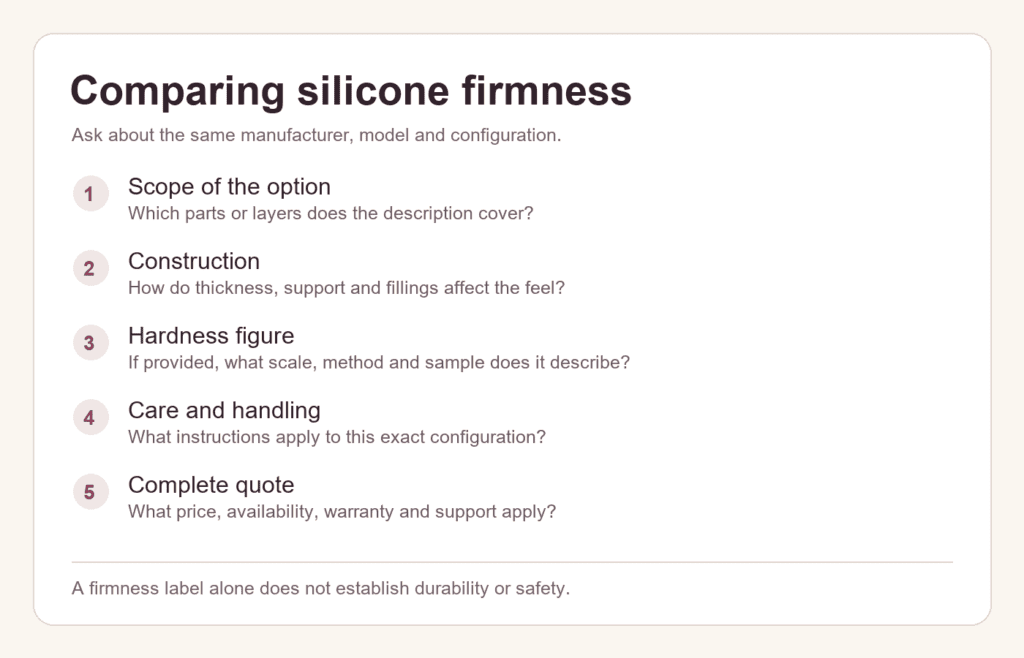
Ask the seller for an itemized comparison and keep the answers with the order. For a LevDoll product, contact the store with the product link and the options you are considering. A manufacturer example in this article does not confirm that a particular option is currently offered by LevDoll.
Consider your preferred feel alongside body dimensions, weight, handling, appearance and available support. A more yielding option may appeal to one buyer and a firmer one to another; neither description alone establishes better value or a universally more realistic result.
If you are also comparing different body materials, our silicone and TPE comparison offers broader context. Use the actual product instructions to make the final comparison, and ask the seller to clarify any differences between the listing and the manufacturer’s documentation.
No. The preferred feel is personal and depends on the construction and intended use. Compare options offered for the exact body.
Not necessarily. Ask which parts and layers the description covers and whether local fillings or other materials are used.
No. Ask for the scale, method and sample being described before comparing figures; a bare number is not enough.
Hardness alone does not establish lifespan. Ask for model-specific care, warranty and repair information.
No. A hardness measurement is not a certification or a biological safety test. Request evidence for the specific claim and finished contact surfaces.
No. Availability and construction depend on the manufacturer and configuration. Confirm the current options with the seller before ordering.