Address
15 Qingnian West Road, Shiyan Subdistrict, Bao’an District, Shenzhen, Guangdong, China.
Work Hours
Monday – Friday: 24 Hours
Weekend: 24 Hours
Complete guide to technological innovations. Learn about features, benefits, maintenance, and buying tips. Comprehensive review with expert recommendations.
Last Updated: November 11, 2026
A “food-grade silicone” label on a doll listing is a claim worth examining, not a complete explanation of the finished product. Ask which material it describes, what food-contact use is claimed and what documentation applies. A statement about food contact does not by itself establish suitability for every kind of body contact.
This guide helps buyers read the scope of a food-contact claim and request supporting evidence. It does not determine the regulatory status of a specific doll, claim to have tested a product, or provide legal advice.
A seller may use “food grade” to describe a raw silicone ingredient, a molded sample, an individual component or a finished surface. Ask which one is meant and which parts of the exact model contain that material. The head, body, removable components, coatings, pigments and adhesives may not all be covered by the same document.
A material supplier’s document can be useful for identifying an ingredient and its stated use. It does not automatically establish that the finished product, including added finishes and other materials, was evaluated in the same way. Request a description of how the evidence relates to the item and current configuration you are considering.
If a report or meaningful explanation cannot be provided, treat the specific claim as unverified. Missing documentation does not by itself prove the product unsafe; it means the claim cannot be checked from the information available.

Food-contact evidence concerns a substance or material in defined circumstances involving food. The identity of the substance, its supplier, intended conditions and the document’s scope matter. A listing may omit those details, so ask the seller to identify the relevant documentation and explain its connection to the finished item.
The FDA explains how it regulates substances that contact food in the United States, including different pathways and specified intended uses. This information concerns food-contact use; it is not an FDA approval of an entire doll and does not determine the product’s status in another jurisdiction.
A food-contact statement does not mean silicone is edible. Nor does it establish suitability for contact with mucous membranes, protection against infection, freedom from allergic reactions, or the durability of the finished product. Those are separate questions requiring relevant evidence and instructions.
Ask which U.S. regulatory basis the seller claims applies to the identified substance and intended food-contact use. FDA describes more than one possible basis; do not assume that every material requires the same notification or that a single universal certificate covers all uses.
The FDA’s explanation of food-contact material components discusses substance identity, specifications and conditions of use. It also explains that an effective food-contact notification is specific to the identified manufacturer, substance and conditions. A notification for one supplier or use cannot simply be assumed to cover another.
A citation to an FDA page, an FDA logo or an unexplained number is not enough to verify a particular product claim. Ask for the document and the seller’s explanation of the named substance, manufacturer and use. The FDA pages cited here address U.S. food-contact rules; they do not classify or approve this doll.
Look for the material or product name, supplier, sample description, date, test method or stated regulatory basis, and the exact use or conditions covered. If a report identifies only a raw ingredient, ask whether evidence exists for the finished contact surface and any relevant coatings or components.
A test report describes what was tested under its stated conditions; a supplier declaration describes a claim by the issuing party. Ask who issued the document, whether it refers to the current formulation and how it can be verified. A partial image or a document for a similar product may leave the key connection to your order unresolved.
Do not infer a blanket product certification from a single test. A report’s result must be read within its scope, and a food-contact assessment does not answer every question about other contact types or personal sensitivities.
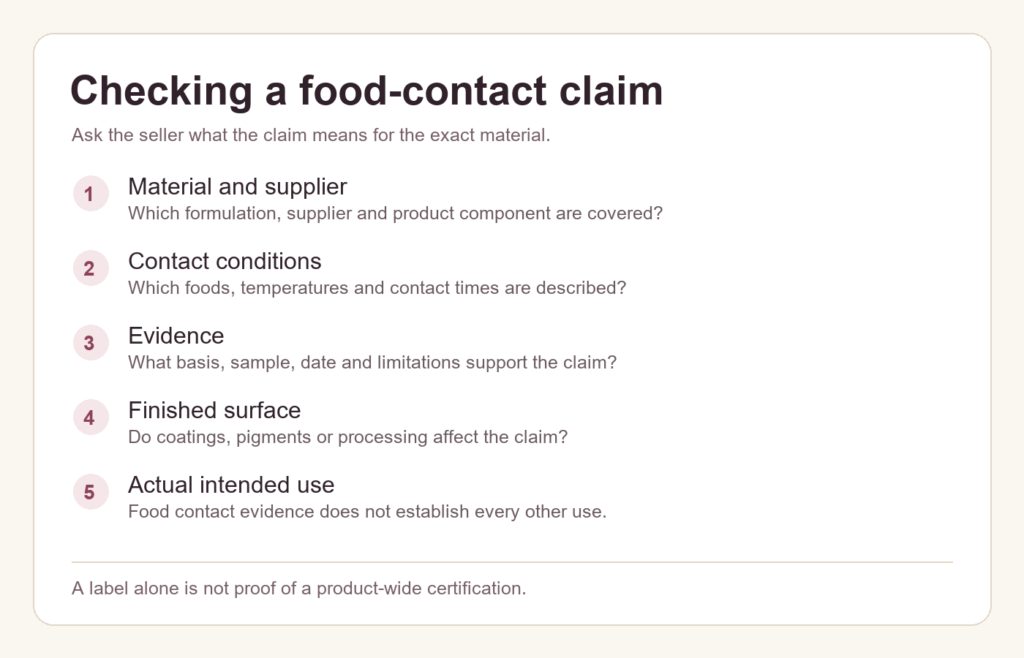
Keep the product listing and the seller’s written answers with your order. For a LevDoll listing, contact the store with the product link and ask which documents support the claim for that configuration. Do not assume an item’s specifications or that a report exists until the seller confirms them.
“Food grade” and “medical grade” should not be used as interchangeable proof of suitability for an adult product. A food-contact claim concerns its stated food-contact context; a medical-related claim needs its own supporting scope. Neither phrase alone verifies the complete product or replaces instructions for its intended use.
The silicone and TPE comparison provides general material context, but material names do not establish the test status of a particular finished item. Ask about body-contact surfaces, compatible care products and any available model-specific evidence.
Rules and documentation can differ by jurisdiction and intended use. For a compliance decision, ask the seller and consult an appropriately qualified regulatory professional in the relevant market. This article is general information, not legal advice.
Individual sensitivities vary. No food-contact claim proves that a product cannot cause irritation or an allergic reaction. If discomfort or an unexpected reaction occurs, stop use and consult a qualified healthcare professional as appropriate.
Not necessarily. Ask which raw material, component or finished surface the document covers and whether it matches the model.
No. A food-contact claim does not mean the silicone or finished product is intended to be eaten.
No. Food-contact evidence concerns its specified use and does not by itself establish suitability for a different kind of contact.
Do not assume a single pathway applies to every material. FDA describes multiple possible regulatory bases for specific U.S. food-contact uses.
No. A reference to food-contact guidance or a material authorization does not establish FDA approval of the finished doll.
The specific claim cannot be verified from the information available. Ask for clarification or evidence tied to the exact material and model.