Address
15 Qingnian West Road, Shiyan Subdistrict, Bao’an District, Shenzhen, Guangdong, China.
Work Hours
Monday – Friday: 24 Hours
Weekend: 24 Hours
Address
15 Qingnian West Road, Shiyan Subdistrict, Bao’an District, Shenzhen, Guangdong, China.
Work Hours
Monday – Friday: 24 Hours
Weekend: 24 Hours
Complete guide to plus-size love dolls. Learn about features, benefits, maintenance, and buying tips. Comprehensive review with expert recommendations.
Last Updated: November 11, 2026
A thorough clean begins with the instructions for the exact product, not a stronger cleaner or more water. Body materials, painted finishes, removable parts and electronic features can require different care. Identify each area before deciding what can be cleaned and how.
This guide covers planning, surface care and drying for the whole doll. Follow the manufacturer’s instructions for the particular model and use; if an area or product is not covered, ask before proceeding. Cleaning removes residue as directed but should not be described as sterilization or a guarantee against infection.
Find the manufacturer, body model, material and configuration on the order or in the manual. Check for painted details, hair, removable accessories, seams, openings, heating or sound features, connectors and controls. A care guide for a similar product may not cover these differences.
Read the instructions for each area and ask what frequency applies to your use. For example, the Sino Doll care guide describes its own routine care and drying recommendations. Its directions are for its products; they are not a universal recipe for every material or finish.
Choose enough space to handle the product and keep its weight supported as the manufacturer directs. If moving it is difficult, arrange appropriate help. Have the approved supplies ready and keep unapproved chemicals away from the work area.
Check for tears, loosened finishes or exposed components before cleaning. Stop and ask the maker how to proceed if damage might allow moisture into a protected area. Keep the instructions accessible so that you do not have to guess partway through the process.
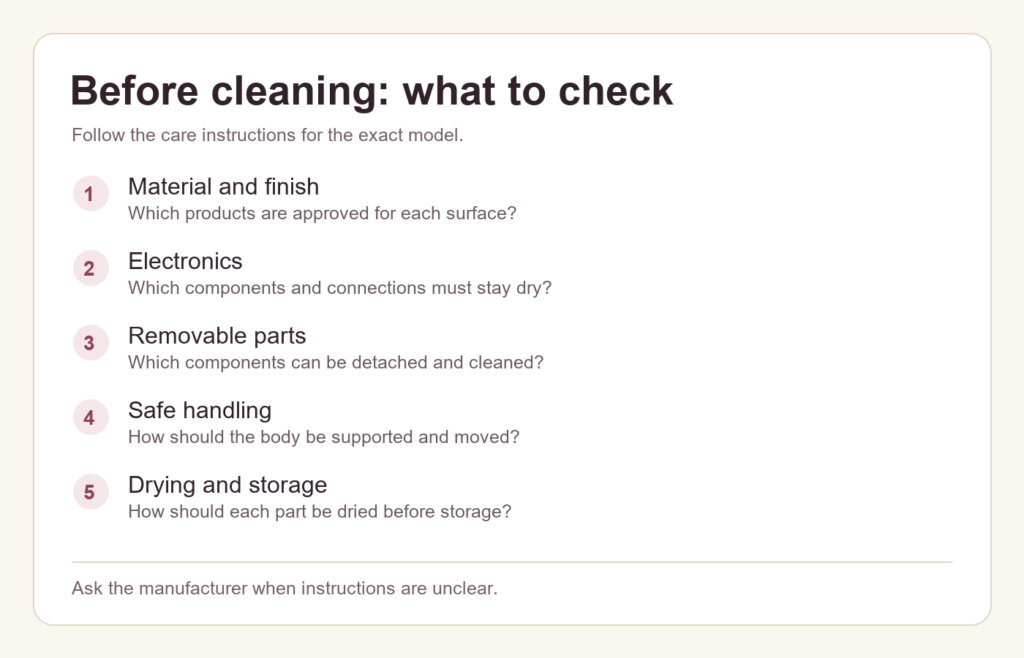
Use only the method and cleaning product approved for the exact material and finish. A general label such as silicone or TPE does not prove that a particular household cleaner is compatible with the complete product. Our silicone and TPE comparison explains broader material differences, but it cannot replace the instructions for your model.
Painted details, makeup, adhesives, hair and other delicate finishes may need separate care from the body surface. Ask which areas can be wiped and what should be kept away from them. Avoid scrubbing, scraping or using a stronger product to remove a stubborn mark; ask the manufacturer for the approved approach.
As one product-specific example, Sino warns against forceful rubbing and several cleaning products on its painted details. A manufacturer’s rule for one finish should not be transferred automatically to another. If the seller and maker provide conflicting advice, obtain clarification in writing.
Identify any charging ports, wiring, controls, heating or sound features and follow the manufacturer’s preparation instructions. Do not assume a product is water resistant because part of its exterior can be cleaned. Keep water and cleaning products away from electrical components unless the maker explicitly specifies otherwise.
Do not immerse the whole product or use a shower as a default cleaning method. The Sino guide specifically says not to submerge its products with electronic features and asks customers to check with support when water compatibility is unclear. Another product may have its own restrictions; confirm them before starting.
Ask the maker which parts are genuinely removable and how each component should be handled. Do not pull, twist or detach a piece simply because it appears separate. Confirm the approved method for cleaning and drying the piece, its connection and the surrounding fixed area.
Follow the model-specific instructions for fixed structures and any recesses. Avoid high pressure, sharp implements and improvised methods. If you cannot reach or dry an area using the supplied instructions, stop and request guidance; do not turn a component inside out or force a tool into it.
Keep compatible parts together and check that both the part and the area it connects to are fully dry before reassembly, as directed by the maker. A separate guide can address the detailed care of specific fixed or removable intimate components; this overview does not prescribe a universal internal cleaning procedure.
After cleaning each approved area, follow the manufacturer’s drying method. Ask how to handle seams, connections and any spaces where moisture could remain. Use only manufacturer-approved materials and avoid unapproved heat, direct hot air or enclosing the product while it is damp.
The Sino guide advises its customers to absorb moisture gently and allow the product to air-dry, with attention to deeper areas. Confirm the applicable drying method for your own model, especially where a removable part or electrical feature changes the process.
Once the product and its approved components are dry, store them as the maker directs in a suitable clean environment. Check the maker’s guidance on supports, covers and contact materials. Do not apply powder, coatings or care products unless approved for the specific material and location.
Contact the manufacturer or seller if you find a tear, exposed electrical component, persistent residue, moisture that cannot be dried according to the instructions, or an unexpected change to the surface. Stop cleaning the affected area and do not experiment with stronger chemicals or repairs.
Have the model and order details ready and explain what part was involved, what approved products were used and what you observed. If appropriate, provide a clear photo. For a LevDoll order, contact the store and request the current instructions for the exact configuration.
Follow the manufacturer’s instructions for your model and how it is used. Ask the maker if the guidance does not cover your situation.
Do not assume so. Confirm compatibility with the body material, painted details, accessories and each removable component.
Do not use immersion as a default. Follow the exact manufacturer’s instructions and keep electrical features protected from water.
Cleaning removes residue when performed as directed. Do not assume it sterilizes the product or guarantees protection from infection.
Follow the maker’s instructions and make sure the component and the area it connects to are completely dry before reassembly.
Stop and contact the manufacturer or seller for model-specific guidance. Avoid unapproved tools, heat, chemicals or repairs.