Address
15 Qingnian West Road, Shiyan Subdistrict, Bao’an District, Shenzhen, Guangdong, China.
Work Hours
Monday – Friday: 24 Hours
Weekend: 24 Hours
Complete guide to doll size selection. Learn about features, benefits, maintenance, and buying tips. Comprehensive review with expert recommendations.
Last Updated: November 11, 2026
A home display area should fit both your space and the requirements of the specific doll. Before choosing furniture or a pose, check its weight, permitted positions, support points and the manufacturer’s instructions. A brief display and long-term storage may require different arrangements.
This guide offers planning questions for privacy, handling and the environment. It does not report product testing or assume that a wall, standing feet or an improvised hook can safely support every model.
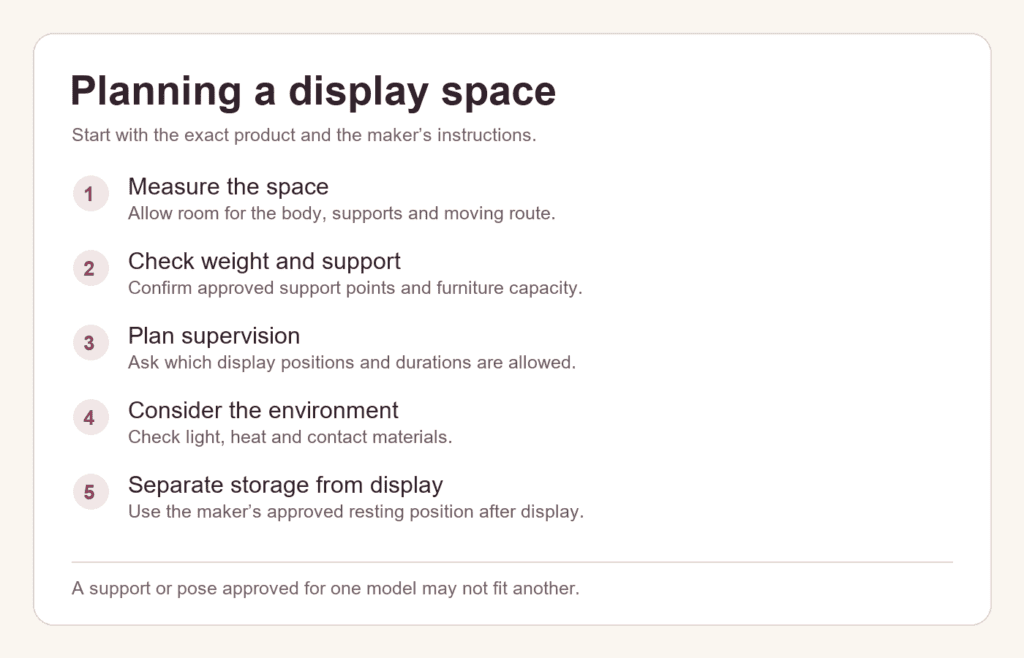
Find the exact manufacturer, model, configuration, dimensions and weight in the order information. Ask which display positions are allowed, what external support is required, how long the product may remain in each position and whether it needs continuous supervision.
Measure the intended area as well as doors, turns and the path from the current location. Allow room for the body, its manufacturer-approved supports and the people assisting with handling. A space that fits the finished arrangement may still be too narrow to move into comfortably.
Consider your ability to support the actual weight. If you cannot move it while maintaining control, arrange help from another adult or an appropriate service. Follow the maker’s lifting instructions and do not pull the entire body by an arm, leg, hand or head.
Ask the manufacturer which positions and contact points are appropriate for short displays. Check the furniture maker’s load rating and condition, and ensure that the complete load and intended use are within its instructions. Consider how the doll, support and furniture will remain controlled throughout setup and display.
A chair, wall or other object should not be assumed to provide adequate support simply because it is nearby. Standing feet are not proof that a doll can stand independently or unattended. Follow the exact maker’s requirements for external support, surface, supervision and duration.
For example, the Sino Doll care guide requires support for its standing-feet products and treats standing as a short-term display rather than long-term storage. This applies to Sino products as described in its guide; it does not define another manufacturer’s standing requirements.
Do not improvise a hanging or neck support. Ask whether the exact body, attachment, stand and mounting location are approved for the intended weight and duration, and follow the manufacturer’s written instructions. If the answer is unclear, use another manufacturer-approved arrangement.
A position approved for a short, supervised display may not be suitable overnight or for long-term storage. Ask the manufacturer which resting position and supports it recommends and which contact points or joint positions to avoid over time.
Plan where the doll will go after display before setting it up. Confirm that the storage surface and any support can accommodate its dimensions and weight. Ask which covers and padding are compatible with the body and finish, and whether periodic checks are recommended.
Sino’s guide describes storage guidance for its own products, including avoiding prolonged pressure and extreme positions. It discusses hanging only where suitable; that does not make hanging appropriate for a different doll, hook or installation.
Check the manufacturer’s limits for sunlight, heat, moisture and contact with other materials. Consider windows, heating appliances and airflow when choosing a location. Sino, for instance, advises keeping its products away from direct sunlight, heat and damp conditions; follow the instructions that came with your own model.
Choose a private location appropriate for an adult product and your household. Consider who can enter the room or see the area through windows. Plan a way to restrict access by children and pets, consistent with the maker’s guidance and the needs of your household.
Ask whether clothing, wigs, dark fabric, leather or printed materials may transfer color to the surface. Select covers and contact materials approved by the maker rather than assuming a decorative fabric is compatible for extended contact.
Before moving the doll, clear the route and remove sharp or unstable objects. Have the approved support and storage area ready. Use the manufacturer’s handling points, move slowly and stop if a joint resists or the body is difficult to control.
If a display requires another person to assist, agree on the move before lifting and avoid sudden twists. Do not use a limb or connector as a handle unless the maker explicitly permits it. If the arrangement shifts or cannot be controlled, stop and ask for assistance.
After the display, return the product to an approved resting position and inspect visible contact areas for new pressure marks, tears, staining or other changes. If you find damage or cannot move the product without force, contact the seller or manufacturer for instructions.
If any requirement is missing, ask the manufacturer before arranging the display. For a LevDoll order, contact the store with the product link, body model and proposed setup, and request the current written guidance.
A practical setup is one you can reach, inspect and return to storage using the permitted supports. Keep the instructions and contact details accessible. Adjust the plan when the furniture, room or product changes, rather than relying on a setup intended for another model.
Do not assume so. Follow the exact manufacturer’s support, supervision and duration requirements.
No. A nearby wall does not by itself establish an approved or stable arrangement. Ask the manufacturer what support the specific model requires.
Not necessarily. Ask which positions and support points are approved for short display and for longer storage.
Do not improvise. Confirm that the exact body, attachment, mounting and intended duration are approved in writing by the manufacturer.
Check the furniture’s load rating and instructions against the complete load, then confirm the maker’s permitted positions and support points.
Stop and arrange help from another adult or an appropriate handling service. Follow the manufacturer’s lifting instructions.