Address
15 Qingnian West Road, Shiyan Subdistrict, Bao’an District, Shenzhen, Guangdong, China.
Work Hours
Monday – Friday: 24 Hours
Weekend: 24 Hours
Complete guide to CLO Doll value. Learn about features, benefits, maintenance, and buying tips. Comprehensive review with expert recommendations.
Last Updated: November 9, 2026
Beginner joint maintenance starts with looking after the whole product: supporting its weight, observing the surface, moving only as instructed and stopping when something changes. A doll’s internal construction is usually not visible, so an external inspection cannot prove that a joint is undamaged.
Use the instructions supplied for the exact manufacturer, model and configuration. This guide covers non-invasive checks and when to ask for help; it does not provide a method to tighten, lubricate, open or repair a joint.
Find the maker, body model, material and configuration in the order record. Keep the current care manual and seller contact details together. Joint designs and permitted movement vary, even among products with similar names or appearances.
Ask the maker which joints move, how the body should be supported, and what behavior should prompt a service request. If a feature was customized, confirm that the instructions cover that version. A video of another doll is not proof that the same adjustment is suitable for yours.
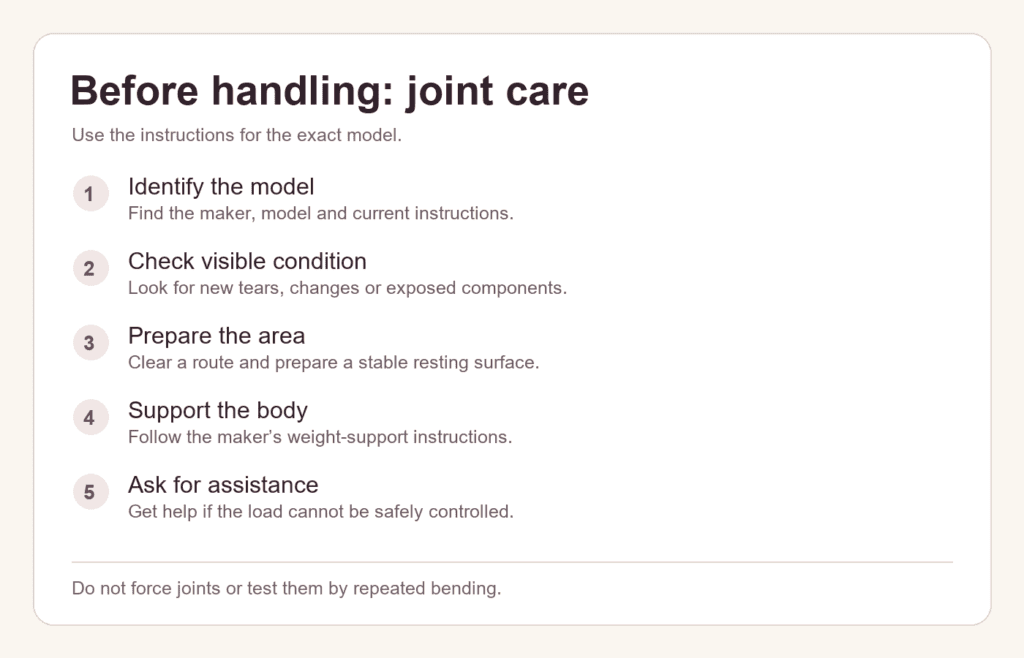
Before handling the product, look at the visible material around its joints and load-bearing areas under good light. Check for a new tear, unusual bulge, exposed internal component, pronounced pressure mark or change in shape. Note where you see it and avoid pulling the area to investigate further.
You can record a clear photograph and compare it with your own earlier condition photos. Lighting, material folds and the product’s position can affect appearance, so a photograph alone is not a diagnosis. If you are uncertain whether a change is normal, ask the manufacturer.
Do not bend a joint repeatedly or push against resistance as a test. Normal stiffness, movement and joint noise depend on the design; a universal force, angle or sound cannot establish that a product is functioning correctly.
Plan the route and prepare a stable place to set the doll down. Consider its actual weight, your own handling ability and available space. Ask another adult or a suitable handling service for help if you cannot support the load comfortably and keep it under control.
Follow the manufacturer’s instructions for supporting the torso and other designated weight-bearing areas. Do not assume a hand, foot, head or limb is designed to carry the whole body. Avoid sudden twists or pulling an extremity to move the product.
The Sino Doll care guide advises customers not to pull its products by limbs, fingers or the head and not to place the full weight on a single joint. Its recommendations are an example for its own products; use the guidance for your specific model.
When a change of position is needed, make sure the body and the area being adjusted are supported according to the manual. Work slowly and give yourself room; check that clothing, accessories or nearby surfaces are not catching on the product.
Stop if movement feels blocked, unexpectedly difficult or different from the product’s usual behavior. Do not force the joint, try a larger movement to free it, or copy an extreme pose. Ask the manufacturer how to proceed and how to support the product while you wait.
The RealDoll Classic care guide tells owners of that model not to force a joint when it resists and cautions that some positions stress its joints and outer material. It does not define the permitted range for a different doll.
Use the storage position and supports recommended for the specific product. A pose held briefly for an adjustment may not be appropriate for storage. Ask the maker how to distribute weight, which covers are compatible and whether it recommends periodic checks during storage.
When dressing the doll, select garments that open enough to avoid forcing limbs or fingers. Keep sharp accessories clear of the surface. If something catches, stop and follow the manufacturer’s instructions rather than pulling on the material.
Clean the exterior only as directed for the material, painted surfaces and electronics. Cleaning the outside is different from servicing an internal joint. Do not apply household oils, sprays or lubricants to joints or surface openings unless the maker provides a specific authorized procedure.
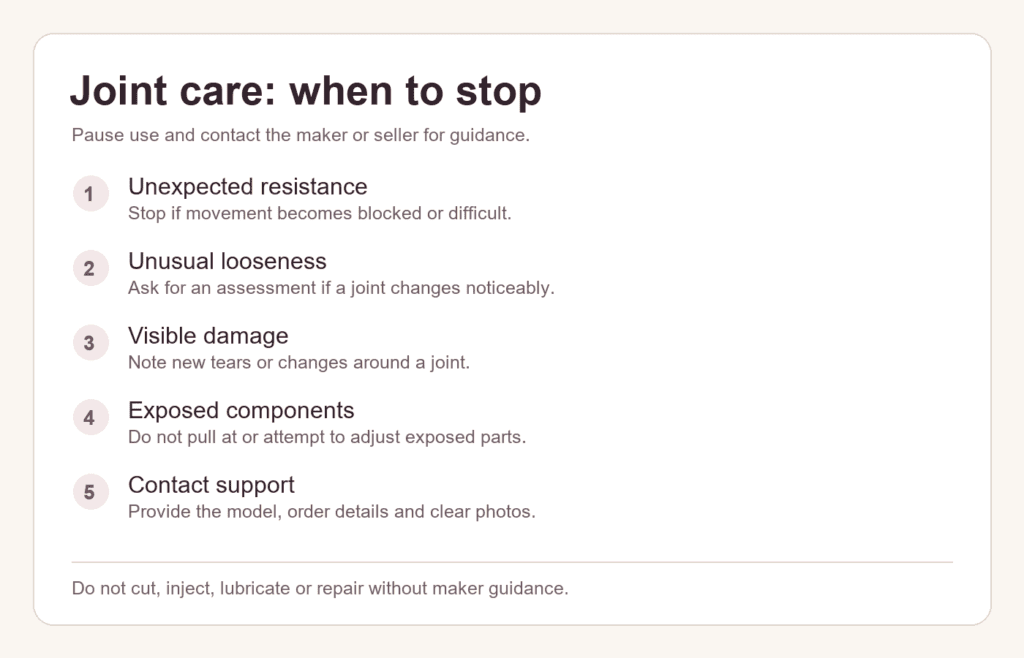
Pause use if you find exposed internal parts, a tear near a joint, an abrupt change in movement, persistent resistance, unusual looseness or another new concern. Support the body in an approved resting position if you can do so without forcing it; if not, ask support for instructions before moving it further.
Share the model and order details, where the issue is located, when you noticed it, and a clear photograph of any visible change. Describe what happened without repeatedly reproducing the problem. Ask whether it should be inspected, what transport instructions apply and whether the service affects warranty coverage.
Do not cut the surface, disassemble the product, inject material or adjust internal hardware on your own. An accurate assessment and any repair need model-specific direction from the manufacturer or an authorized service provider. For questions about a LevDoll purchase, contact the store with the order details.
Follow the manufacturer’s inspection schedule if one is supplied. Observe visible condition before handling and ask the maker if you notice a change.
No. Joint resistance can have different causes. Stop if movement is unexpectedly difficult and contact the manufacturer; do not apply an unapproved product.
Do not repeatedly force or bend a joint as a test. Follow the model’s instructions and stop if movement resists or changes unexpectedly.
Stop handling the affected area, support the body as directed if possible and contact the seller or manufacturer with a clear photo.
Do not assume a limb can carry the full body weight. Follow the manufacturer’s lifting instructions and get help when needed.
Do not open the surface or adjust internal hardware without manufacturer direction. Ask the maker or an authorized service provider for an assessment.