Address
15 Qingnian West Road, Shiyan Subdistrict, Bao’an District, Shenzhen, Guangdong, China.
Work Hours
Monday – Friday: 24 Hours
Weekend: 24 Hours
Address
15 Qingnian West Road, Shiyan Subdistrict, Bao’an District, Shenzhen, Guangdong, China.
Work Hours
Monday – Friday: 24 Hours
Weekend: 24 Hours
Last Updated: September 8, 2026
Choosing a TPE sex doll involves more than comparing faces, body shapes, or prices. The material formulation, softness, weight, internal skeleton, construction method, customization options, and manufacturer quality control can all affect the long-term ownership experience.
TPE is widely used for soft-touch consumer products because thermoplastic elastomers combine rubber-like elasticity with the processing characteristics of thermoplastics. However, “TPE” is a material family rather than a single standardized recipe, so two dolls both labeled TPE can feel and perform very differently. Kuraray Elastomer
This guide explains what buyers should realistically expect from TPE dolls, where the material performs well, where it requires more care, and which specifications matter most before ordering.
TPE stands for Thermoplastic Elastomer.
Thermoplastic elastomers are materials designed to combine the elasticity and flexibility associated with rubber with the melt-processability of thermoplastics. Different TPE families use different polymer chemistries and can have substantially different hardness, chemical resistance, heat resistance, strength, and surface characteristics. KRAIBURG TPE
In very soft consumer applications, styrenic block copolymers such as SEBS are commonly used. SEBS-based compounds can also incorporate oils and other formulation components to achieve very soft, flexible, skin-like textures. Kraton, a major styrenic block-copolymer producer, notes that these polymers can accept high oil loadings and can be formulated into very soft compounds with a skin-like feel. Kraton
That is important for buyers because:
“TPE” on a product page does not tell you the complete material specification.
The actual formulation matters.
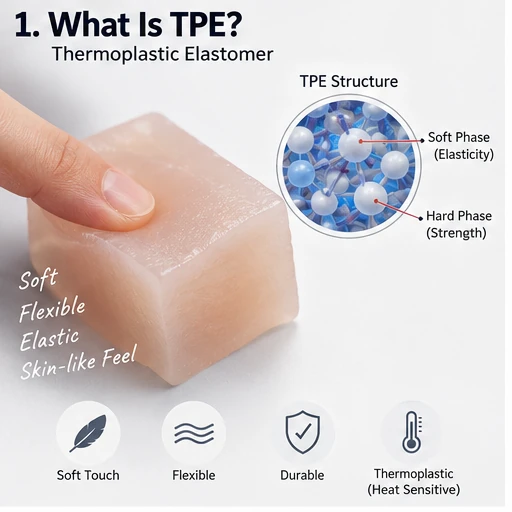
TPE can be formulated across a broad hardness range.
In styrenic TPE systems, manufacturers can adjust polymer composition, hard and soft phases, fillers, and oil content to modify flexibility and mechanical behavior. Very soft formulations may even be characterized using softer hardness scales rather than the conventional Shore A scale. SpecialChem
This explains why one TPE doll can feel substantially softer than another even when both product pages simply say “TPE.”
Softer is not automatically better.
An extremely soft compound may provide a more yielding tactile feel, while a firmer formulation may provide greater shape support or better resistance to deformation in some applications.
When comparing products, ask the manufacturer whether they can provide information about:
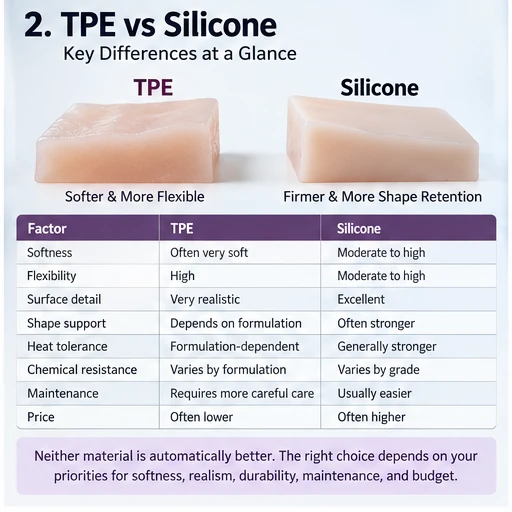
Neither material is universally superior.
The most useful comparison is based on the buyer’s priorities.
| Factor | TPE | Silicone |
|---|---|---|
| Softness | Often very soft and flexible | Depends heavily on silicone formulation |
| Elastic feel | Usually high | Moderate to high depending on grade |
| Surface detail | Can be very realistic | Often excellent for fine molded detail |
| Shape support | Depends on formulation | Often stronger |
| Heat tolerance | Formulation-dependent; thermoplastic behavior matters | Generally stronger thermal stability |
| Chemical resistance | Varies substantially by TPE family | Also formulation-dependent |
| Maintenance | Usually requires careful material compatibility | Usually somewhat easier |
| Price | Often lower in the doll market | Often higher |
| Material consistency | Highly formulation-dependent | Highly formulation-dependent |
The biggest mistake is assuming every TPE behaves the same.
Chemical resistance, for example, varies significantly between TPE chemistries and formulations. HEXPOL notes that SBS/SEBS compounds can show degradation after prolonged exposure to some organic solvents, oils and fuels, while Avient similarly recommends testing the actual final formulation for its intended chemical exposure. Hexpol
→ Silicone vs TPE Comparison Guide
No.
This is one of the most important points buyers should understand.
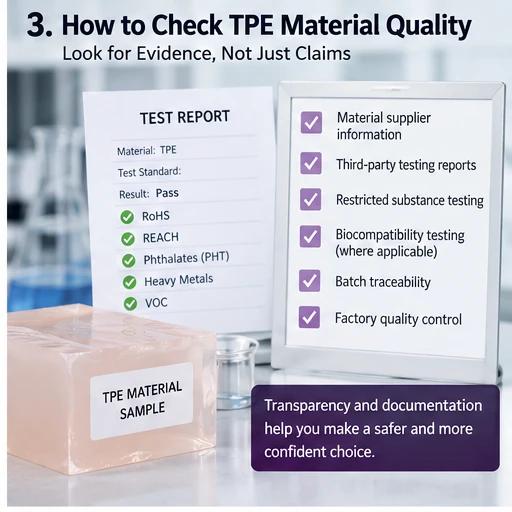
The term TPE does not itself prove biological safety.
There are TPE grades specifically developed for medical, skin-contact and food-contact applications. For example, manufacturers such as Kuraray and KRAIBURG offer particular TPE grades with specific compliance or biocompatibility documentation. But the existence of medical-grade TPE does not mean every TPE compound automatically meets those standards. Kuraray Elastomer
Similarly, ISO 10993 is a framework used for the biological evaluation of medical devices. FDA guidance explains how ISO 10993-1 is used when evaluating the biological safety of medical-device materials and contact conditions. U.S. Food and Drug Administration
Therefore, statements such as:
“Made from medical-grade TPE”
should ideally be supported by documentation identifying the actual material and relevant testing.
A better buying question is:
What specific material testing or supplier documentation is available for this doll?
Not simply:
“Is TPE safe?”
A trustworthy seller should be able to provide more than vague claims such as “premium TPE.”
Useful evidence may include:
A certificate should also be read carefully.
For example, a report showing compliance with a specific chemical restriction does not automatically prove every possible aspect of biological safety.
At LevDoll, material documentation should therefore be treated as evidence for what was actually tested, rather than as a blanket guarantee about everything the material could be used for.
→ Material Safety & Certification Center
Some very soft TPE formulations do.
This is especially relevant to styrenic block-copolymer systems. SEBS-based compounds can be formulated with mineral or paraffinic oils to modify softness and processing characteristics. Technical literature and polymer suppliers describe oil-extended SEBS compounds and the use of oils in creating soft formulations. Kraton Corporation
This helps explain why some TPE products can develop a slightly oily surface over time.
However, the amount of surface oiliness depends on formulation, manufacturing quality, temperature, age and other factors.
A very oily surface should therefore not simply be treated as “normal TPE” without considering the specific product.
Very important.
Full-size dolls can be difficult to move regardless of material.
Do not choose a doll based only on height.
Two dolls of similar height may have significantly different weights because of differences in:
Before ordering, check the actual finished weight shown for the exact configuration you intend to buy.
If you expect to frequently:
then weight may matter more in everyday ownership than several cosmetic upgrades.
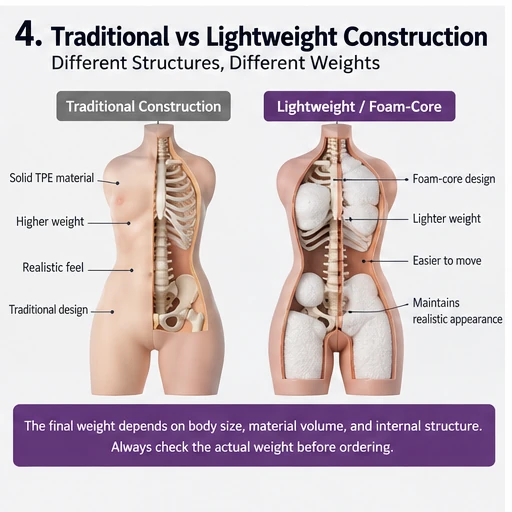
The TPE exterior determines softness, but the skeleton determines much of the doll’s posing behavior.
Depending on the manufacturer and model, buyers may encounter features such as:
More joints do not automatically mean a better doll.
Additional articulation can increase posing possibilities, but it also introduces more mechanical complexity.
Before paying for a skeleton upgrade, consider whether you actually need the additional range of motion.
Avoid claims such as:
“TPE lasts X years.”
There is no reliable universal lifespan for a TPE doll.
Durability depends on:
TPE mechanical properties are influenced by material chemistry and the proportions of hard and soft phases. Softer formulations can behave differently from firmer ones, so softness alone should not be used as a measure of quality. SpecialChem
Areas subject to repeated bending or concentrated stress generally deserve particular care.
Because TPE is thermoplastic, its mechanical behavior changes as temperature increases.
Different TPE chemistries have different service-temperature ranges, so there is no single safe maximum temperature that applies to every TPE doll. Technical references consistently emphasize that thermal performance depends on the specific formulation. Xometry
For practical ownership:
Do not boil or expose a TPE doll to very hot water unless the manufacturer specifically permits it.
Chemical compatibility also varies.
Avoid assuming that:
is compatible with TPE.
Material suppliers recommend compatibility testing because exposure time, concentration and the exact compound can all influence the result. Avient
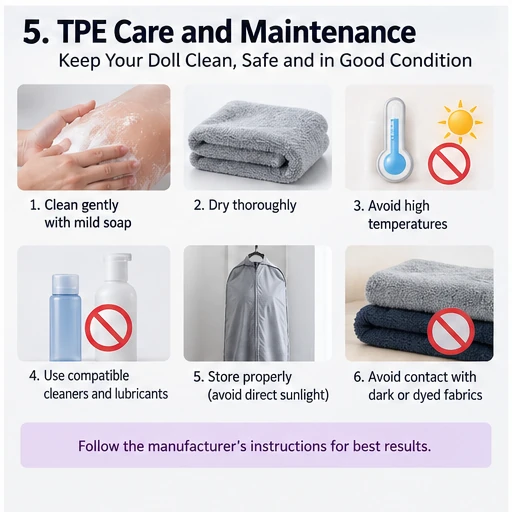
For routine care, follow the specific doll manufacturer’s instructions rather than generic internet advice.
A practical maintenance routine should focus on gentle cleaning and complete drying.
General principles include:
Because TPE formulations differ, a product that is compatible with one TPE compound may not be appropriate for another.
Odor can vary between products.
Differences may result from the formulation, additives, manufacturing process, packaging and storage.
A low odor can improve ownership experience, but odor alone is not a reliable test of material safety.
Likewise, a stronger smell should not automatically be interpreted as proof that a material is dangerous.
Actual material documentation is more useful than smell-based judgments.
It is easy to spend heavily on options that look attractive on a configuration page but have little impact on everyday ownership.
Prioritize functional decisions first:
Can you comfortably move it?
Do you actually need enhanced posing?
Will you use standing poses or vertical storage?
Standard, softer or gel-style construction can feel different.
Check compatibility and ease of removal.
Articulated fingers can improve posing but may require more careful handling.
Then consider cosmetic options such as:
There is no single correct price.
Instead of focusing only on the lowest advertised price, compare what is actually included.
The final price may depend on:
A cheap listing may represent good value — or it may simply omit expensive features.
Compare like with like.
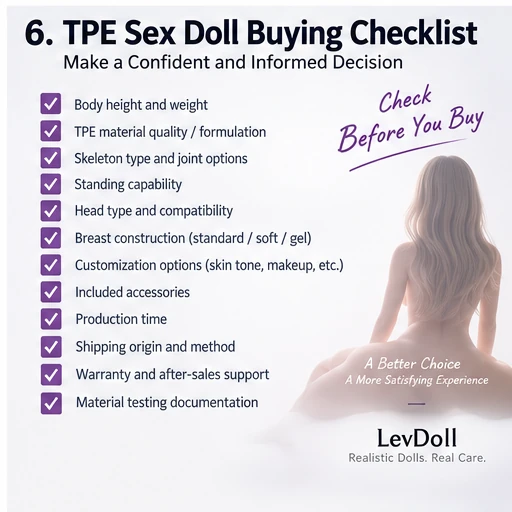
Before paying, verify:
Manufacturer
Who actually produced the doll?
Material
What type or grade of TPE is being claimed?
Real product photos
Are the images representative of the product being shipped?
Weight
Is the listed weight realistic for the body size?
Options
Which features are standard and which cost extra?
Warranty
What happens if there is shipping damage or a manufacturing defect?
Shipping origin
Is the doll shipping from China, the US, Europe or another warehouse?
Documentation
Can the seller provide traceability or material documentation where appropriate?
A trustworthy buying process should make these points clear before payment.
Before ordering, confirm:
Save your final confirmed configuration before payment.
No. TPE is a broad family of thermoplastic elastomers, and manufacturers can use different polymer systems, hardness levels, additives and formulations. SpecialChem
No. Softer TPE may provide a more yielding feel, but material performance also depends on mechanical strength, formulation, thickness and the design of the doll.
No. Medical-grade TPE refers to specific material grades supported by appropriate documentation or testing. The generic term TPE does not establish medical-grade status. Kuraray Elastomer
In the adult-doll market, TPE models are often positioned below comparable silicone models, but price varies greatly by manufacturer, body size, skeleton and options.
TPE is thermoplastic, so heat can change its mechanical behavior. Exact temperature limits depend on the formulation, so users should follow the manufacturer’s instructions. Avient
No. Chemical resistance varies across TPE formulations. Use products specifically confirmed as compatible by the doll or material manufacturer. Avient
There is no universal lifespan. Material formulation, manufacturing quality, handling, storage, heat, chemical exposure and maintenance all affect durability.
TPE can be an excellent material for buyers who value softness, flexibility and a wide range of available body designs. But the word TPE alone is not enough to judge quality.
The strongest buying decision comes from evaluating the complete product:
material formulation + weight + skeleton + construction + manufacturer quality + documentation + after-sales support
Do not automatically assume that the softest doll is the best, that all TPE is “medical grade,” or that two products labeled TPE will perform identically.
A transparent seller should help you understand exactly what you are buying rather than relying on vague material claims.
Ready to explore available models?
Browse our TPE Sex Dolls to compare different body types, weights, skeletons, materials, and customization options.